4 Things Your Brand Can Learn From Grumpy Cat
The internet was made by and for cats. What other possible explanation could there be for the crazy sensation known as Grumpy Cat? But as you indulge yourself in a private moment of mourning over her death earlier today, it’s never too soon to think about the lessons we can apply from her fame. The internet’s backbone, after all, is shamelessness so let’s dig into the litter box.
Defining How A Brand Is Perceived
For starters, let’s define a brand. There are four main categorizations of brands: good, bad, strong, weak. On an X and Y axis graph, it looks like this.
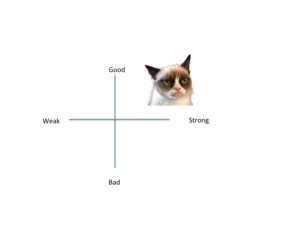
Grumpy Cat had what would be considered a strong and good brand.
While Grumpy Cat had both a strong and a good brand, those two things don’t necessarily go hand-in-hand. United Airlines, for example, has a strong brand that’s bad because people know about United for all of the wrong reasons. Ideally, you want your brand in the same quadrant as Grumpy Cat.
How Did Grumpy Cat Become A Good Brand?
Our late feline friend played into an existing stereotype: cats are as%^&les. It’s a given they are self-serving and contemptuous of all life around them. So when Grumpy’s owner, Tabatha Bundssen, began placing pictures of Tardar Sauce (the cat’s real name) online, it existed in a milieu people could understand. Everyone was in on the joke.
Tardar also had a compelling background story to explain her unique facial expressions, feline dwarfism, which made her more relatable both to cat lovers and cat agnostics.
How Did Grumpy Cat Become A Strong Brand?
One of the cornerstones of every strong brand is their uniqueness. There are tens of millions of cats in the world, but none of them look like Tardar Sauce, and none have the same facial expressions. If you’re brave, you can put a cat in a costume, but it won’t have the same impact. A strong brand has to have a hook.
And in this social age, your brand has to be sharable. Ms. Bundssen, Grumpy’s owner, encouraged Photoshopped memes of her cat across all social platforms. At the time of her death, Grumpy Cat had 2.4 million Instagram followers and 1.5 million Twitter followers. What she didn’t have was a team of lawyers threatening to sue anyone who used Grumpy’s likeness. While you have to protect your brand for commercial purposes (and Grumpy’s owners did), it can often help to loosen your grip a little and let people be creative.
Good Brands Must Be Likable
As I mentioned earlier, companies like United, Volkswagen (and lately) Facebook have strong brands, but no one would associate the adjectives most people use to describe these companies as positive. Words like deceitful, uncaring, greedy and intrusive have become synonymous for these companies. They would all exist in the lower right quadrant of the graph above.
Strong Brands Must Be Consistent
One of the reasons Grumpy Cat had so many fans is her fans knew what they were going to get. No matter the meme or the costume, every picture had her frowning face to either enhance or juxtapose it. Had she suddenly appeared as content and happy, her brand would have lost its edge. What was so devastating about a United gate agent dragging an unarmed man off a plane was United had used the slogan “Fly The Friendly Skies” for years. Talk about cognitive dissonance for their audience!
Everyone Loves Animals
There’s a reason Geico’s brand uses a Gekko, and Frosted Flakes has a tiger. Humans love and identify with animals. Neuropsychologists have been studying the use of animals to increase brand identity for years, and the research is clear: it works. So if all else fails, and your brand can’t get any traction or has a likeability problem, don’t just bring Fido to work; put him in front of the camera. You know you already think he should be famous. After all, if it worked for that angry cat. How hard can it be?
The post 4 Things Your Brand Can Learn From Grumpy Cat appeared first on Michael's Marc.