
It's Open Season On Data Centers & AI
Labor Day traditionally means the start of political campaign season.
Usually, that means your mailbox, your social media feeds, your audio streaming, and your favorite shows will be cluttered with ads from candidates up and down the ballot making promises about how they are going to improve your life. (Disclosure: The person writing this article used to do this for a living.)
Those ads are designed to raise your blood pressure, open up the flow of dopamine, or appeal to your sense of self-righteousness, which is why so many of them focus on hot-button issues like abortion, guns, and immigration.
This year, however, there’s a new entrant into the hot-button lexicon: AI. And it has barged into political campaigns with the same speed it’s pushing into every sphere of American life.
According to a recent Washington Post poll, the number of candidates talking about AI this year exceeds those talking about race, manufacturing, or the Middle East, and Americans' sour mood about AI is becoming an inescapable fact for campaigns.
This isn’t limited to states like Texas and Virginia, where the largest number of data centers to power AI have been built. Candidates running for governor or Congress in 45 states have made AI a part of their campaign. And the state where the highest percentage of candidates are talking about AI? Utah, where Kevin O’Leary is trying to insult his way into building a data center that uses more electricity than the entire state.
Incumbent politicians who’ve previously laid out the welcome mat for data centers in their state are feeling the backlash. You know your industry has a public relations problem when all-economic-development-is-good Texas Governor Greg Abbott has done an about-face and is now campaigning for re-election on restraining data center development.
A recent Gallup Survey showed that opposition to data centers is so intense that more Americans would rather live near a nuclear power plant than one designed to fuel AI.
I wrote recently about how the hyperscalers behind the massive data center build-out could take meaningful steps to address the rapidly boiling public anger at their industry, and just this week, Meta founder Mark Zuckerberg published a letter announcing the company’s billion-dollar ‘Future Is For Everyone Fund,” a compact between the company and the communities where they build their AI facilities.
This follows similar announcements in recent months by Microsoft and Google.
Clearly, the public affairs professionals within those companies have gotten the attention of their C-Suite bosses. But what also has gotten their attention was the 75 data center projects that were blocked in the first quarter of 2026, worth $130 billion. That matched the number of data center projects blocked in 2025.
Going big with a billion-dollar community investment plan is smart public relations for Meta; however, it’s a proverbial drop in the bucket compared to the lost opportunities due to past ill behavior.
The good news if you’re Apple, Amazon, Meta, Google, X, or Microsoft is that unlike other hot-button issues like guns or abortion, people’s opinions about AI haven’t calcified. When a constituent asks a candidate what their position is on abortion, for example, they want to know if the candidate is pro or anti. A candidate might have a more nuanced position, but the voter doesn’t.
Because AI isn’t tangible for most people beyond their uncertainty about the job market, privacy, and children’s safety, there’s still an opening for opinions to change.
The same can’t be said about data centers that enable AI development. They are VERY tangible because of their footprint, the electricity they consume, the water they use, and the pollution they emit.
No societal transformation comes without some degree of fear, uncertainty, and opposition. However, two things separate those who changed our infrastructure in the past from those on today’s front lines.
Railroads, highways, and electrification created massive amounts of construction jobs and brought immediate improvements in families’ quality of life. Those jobs went to millions of households that benefited from lighting and heating in their homes and businesses, making them more comfortable and more profitable.
Data centers can’t hire millions of workers to build them by posting on Indeed because of the skills required. It’s not the fault of technology companies that there’s a shortage of trade workers in this country. But it’s also true that once a data center is built, the public cannot readily see its own place in the bargain. And unlike highways, railroads, and utilities, there isn’t a large need for workers to operate and maintain a data center once it’s built.
Then there’s what I call your Andrew Carnegie problem. In America’s last Gilded Age, Andrew Carnegie sold himself as the champion of the working man based on his rags-to-riches background. Publicly, he proclaimed to be a friend of the working man and touted the benefits of trade unions. However, his record belied those claims, most notoriously as his minions hired Pinkerton Detective Agents and the state militia to break a strike at his Homestead Steel Mill and rid it of union employees.
Carnegie’s reputation only recovered after he sold his steel company to J.P. Morgan in 1901 and gave away more than $350 million, including the establishment of more than 2,500 public libraries around the world in the 18 years between the sale and his death.
Right now, the public sees you as middle-aged Andrew Carnegies. Your origin story might be modest, but no one cares. The public sees your CEOs as greedy titans who will do or say whatever is necessary to achieve domination, whatever the cost.
Your recent community commitments are reminiscent of the words of a steel worker who quipped about Carnegie’s charitable endeavors, “After working 12 hours, how can a man go to a library?”
You can’t whitewash years of bad behavior that have convinced a majority of the public that you’re bad actors who shouldn’t be trusted because you’ve profited from societal division and addicting children on your social media platforms, invaded people’s private lives, or bullied towns, cities, and counties for tax breaks that drove up the cost of services for everyone else.
Carnegie’s $350 million would be worth over $12 billion today, pennies on the dollar of what you’ve already lost in stalled or rejected data center projects.
The community commitments are great, if long overdue. But they will neither paper over the public perception of your motives, nor will they lower the public’s anxiety about where they fit into the future.
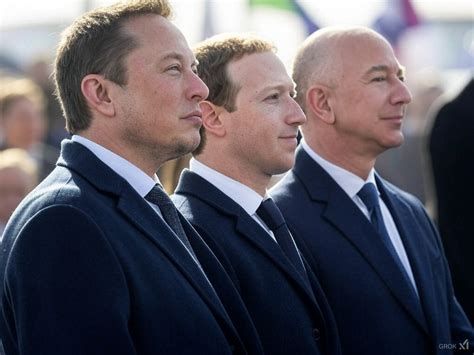
In addition to starting with a mea culpa, how about spending some of that money to start a national discussion about this economic transformation that you’re leading? Mark, Jeff, Elon, Sergei: see first-hand if your vision will play in Peoria. Listen to the real anxieties and hopes for your industry and see if there’s a nexus point around which you can build trust and a shared vision for the future. I’m sure CNN would be willing to host it.
You still have a chance to head off some onerous regulations headed your way, but time is short. The first Wednesday in November is the unofficial start of the 2028 Presidential election, and if you think you’re taking some hard hits now, wait until the most ambitious politicians in the country take out their brickbats.