
Memo To The Hyperscalers
In the wake of New York State’s Governor Kathy Hochul signing a 12-month moratorium on data center projects in her state...
...the Data Center Coalition belatedly launched an ad campaign to support the industry and mitigate the brush fires of public opposition that have gone national.
The campaign is called America Connects, and is currently running in six states. Before the Coalition expands that campaign, let me offer some unsolicited advice.
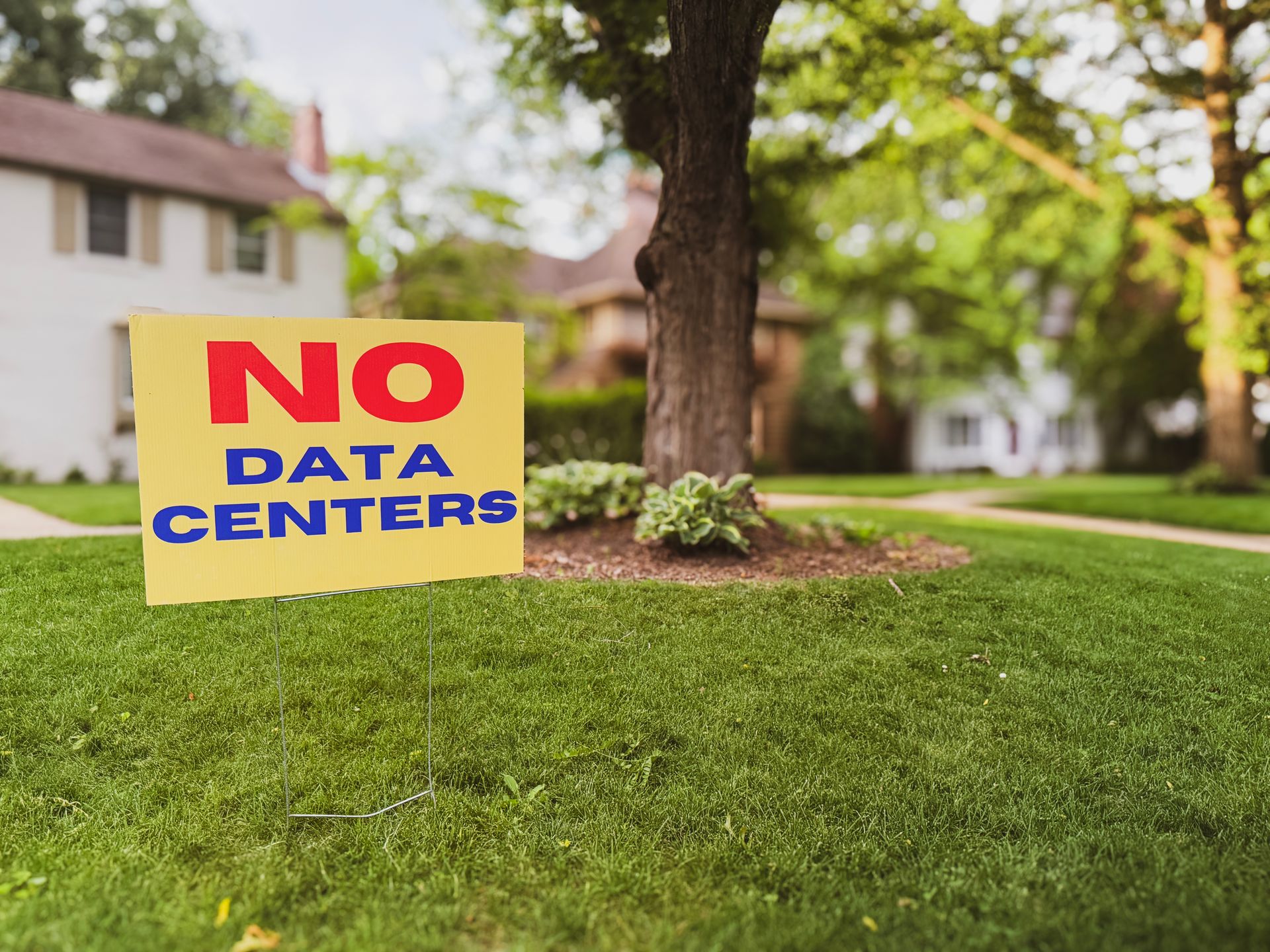
The first two words of your campaign need to be, “I’m sorry.” Your industry has become so toxic (fairly or unfairly) because it has exhibited everything Americans hate about people and institutions that arrogantly display power. Your industry has become one of the few things that unite Democrats and Republicans in this era of extreme polarization, and that’s no small feat.
Over the last decade, you’ve bullied local and state governments for favorable tax treatment, spiked electric rates and guzzled fresh water to power and cool your warehouses of data racks.
Now you’re undertaking a standard public affairs campaign: publishing press releases and economic studies showing the industry’s benefits, disputing what’s become gospel about your energy and water usage, and seeding stories with local press outlets about your local largess.
That’s all well and good, but here’s the problem: Nobody believes you, and they won’t be able to hear you until you take the first step to make amends with Americans and their elected officials.
Skipping this step is tantamount to shouting in space.
Credit to Microsoft for taking positive steps by acknowledging the controversy their data centers cause and starting to change their ways. That doesn’t guarantee burned bridges will get rebuilt, but it signals a willingness to take opposition at face value rather than trying to run over it.
There’s an old saying that you can tell a lot about a person by the people he surrounds himself with. The second problem you need to overcome is that no one likes your friends. Right now, the face of your industry is seven of the least sympathetic human beings on the planet. Their names are synonymous with greed, a lust for power, and emotional detachment.
Even if your economic studies are accurate, the sub-heading of every report is, “Bought and paid for by Musk, Zuckerberg, Bezos, et al.” Nobody is interested in reading Ted Bundy’s manifesto because it was written by…Ted Bundy.
Exhibit A: The worst enemy of your industry isn’t the moratorium-proposing politician. It’s Kevin O’Leary, the living embodiment of Dr. Evil. One way you can show the public you are serious about changing your ways is to take away all his communication devices because he is killing your brand. No amount of positive Wall Street Journal op-eds can compete with his spontaneous outbursts of invective against data center opponents on social media.
And speaking of guests you shouldn’t invite to your dinner party, let’s talk about your association with cryptocurrencies. You’re tying your reputation to an industry already viewed by many as opaque, speculative, and prone to scandal.
Even some of the investors financing the hundreds of billions of dollars spent on AI-enabling server farms are having doubts, wondering about whether these data centers will be required to meet the massive demand for AI computing power. If I’m a local politician who’s already getting flak from constituents about you and I read this, my second thoughts about approving your permit just became third and fourth thoughts.
If you can solve the above problems, then it’s time to tackle messaging, which frankly, is a mess.
For the last several years, your stock response to data center opposition has been two-fold:
- You need us because you have a smartphone
- AI will cure cancer
In Marketing 101, they teach you a few things which have so far eluded the elites of your industry. First, never point a finger at the people who use your product. Almost all of us pay Google, Microsoft, or Apple to house our pictures, videos, and other ephemera. Blaming your customers who are already contributing to your coffers because you’ve successfully monopolized online storage only reminds them that not only do they pay you every month, but now you’re driving up their cost of living with the product you sell them. No bueno.
Let’s deconstruct the second message. There’s the AI part...and then there’s the AI part. Whatever comes after that gets lost. Your titans are overseeing a once-in-a-century economic transition, and people are frightened. Maybe one day artificial intelligence will speed up cures to some of the deadliest diseases mankind has known, but most people live in the here and now—and right now they are afraid of losing the jobs they have that already aren’t keeping up with the cost of living. Politicians can talk about the future because it’s couched in the premise of people’s children and grandchildren. It’s tangible. AI is not.
More recently, your messaging has pivoted to the positive economic impacts data centers bring to local communities, but those messages are as cold and clinical as your server farms. Your Oregon Connects website Benefits page starts by listing GDP, annual operating expenditures, and capital investments. It reads like a public company quarterly report.
Halfway down the webpage (which tells the reader that it’s not a top concern), you address job creation with more numbers. (Note: there’s a reason the root word of numbers is ‘numb.’) No images, no testimonials of trade workers who build your facilities; just cold, hard numbers. The whole page feels like it was written by Claude. Your homepage video features one stock clip after another, and an AI-generated voice. Talk about reverting to typecasting.
So, to sum up: you’ve got some problems, and by no means is messaging the only one, but since it’s one I’m qualified to tackle, here are a few suggestions:
First, let’s get this out of the way. You’re going to demagogue China. You know it. We know it. And they know it. Fear of the pinkos is how Eisenhower sold the national highway system, and how Kennedy sold the Apollo missions. Unfortunately, it’s as American as hot dogs and apple pie. But when you do it, don’t just wave the bloody flag. Yes, China is a rival for AI supremacy, but since Americans are largely wary of AI, playing the communist card alone won’t work. The Department of Defense is your best ally here because the military is the one institution left in America that’s still trusted. Let them make the case for national security. Your job is to connect the dots to specific industries that will employ Americans…if the Chinese don’t win the AI race.
Setting aside geopolitics, here’s a plan to get out of public purgatory:
Connect your product to tangible concerns. Data centers are everywhere, but most people never notice them because they aren’t housed in arena-sized configurations. HMO’s and hospitals co-locate them to access patient records and to protect them from piracy. Instead of using stock video clips, consider a hospital administrator delivering that message from behind her desk, or an ER doctor or nurse for whom seconds matter and who depend on fast, reliable data access to save lives to make your case.
Let your EPCs become your face. People can relate to the welders, electricians, and plumbers who can support their families because of the infrastructure you invested in. The companies that build your projects are local, and many of them are community pillars. Leverage that goodwill and stand as close as you can.
Boast about onshoring. Recently, the industry has made commitments to power its own data centers separate from the electric grid. Good. Now take the next step and tell everyone how those solar panels, inverters, ingots, and batteries support a supply chain of domestic jobs.
Demystify your industry. Few people have ever been inside a data center, and there are many reasons, from security and cleanliness to remote locations (and it’s less interesting than a trip to the zoo). But people are more suspicious of things they don’t understand. In a world where anyone can get information 24/7, that information is often more hyperbolic than factual. Data centers are especially susceptible to hysteria because they are essentially black holes.
Nuclear energy is a useful comparison. For decades it was radioactive, both literally and metaphorically, because its risks were at the forefront of people’s fears, even if they believed in its potential. Even people who supported it generally didn’t want to live near a facility. It’s experiencing a renaissance recently, mostly as a carbon-free baseload energy source, but I’d also argue that, ironically, it’s also due to Americans’ exposure to The Simpsons. They made it acceptable to laugh at, rather than fear fission. If Homer Simpson could work there, the science couldn’t be that complicated, could it?
Be at the forefront of reviving America’s trades. Underwrite tuition at community colleges and trade schools; not just a few scholarships…a million of them. Run an ad campaign as big as the national America Connects campaigns targeted at young men and women who couldn’t afford to or didn’t have the grades to attend a four-year university, that there’s a future for them in building data centers. Hell, open your own university, and train these young people inside your ecosystem. Google is already spending $50 million in select locations to expand apprenticeship enrollment in the building trades by 10,000, and it’s still pennies on the dollar compared to what you are spending on the effort to build artificial intelligence. Where are the display ads on YouTube, the ads on Instagram, and a national broadcast campaign that unmistakably says to Gen Z that thinks you’ve undermined their future that they are indeed part of a plan for broad-based prosperity?
Going forward, enlightened self-interest is your best friend. I’m sure there’s internal debate about where that line exists, but the 116 municipalities that have imposed moratoriums or prohibitions against data centers are just the start. Wildfires don’t extinguish themselves until they’ve burned all the fuel that can be consumed. Politics and public opinion follow the same path. Prohibitions, whether by executive order or legislative fiat, are going to burn hotter, and the genie is not going to get put back in the bottle.
In war, truth may be the first casualty, but in the race to dominate artificial intelligence, it’s trust. Don’t make the mistake of assuming there’s a technological solution for it.