

Is Carbon Capture Coming Of Age?
For years, I was a carbon capture skeptic because the technology has an “S” for storage or sequestration. To me, storing CO2 underground was like asking a smoker to hold his breath to protect everyone around him from the harmful effects of second-hand smoke. Eventually, the lungs are going to exhale.
I realize that’s an imperfect comparison as the Earth has held carbon in its strata for millions of years until we dug it up, and the more wishful interpretation is CCS is putting the carbon back where we found it, or what I call the toy box theory. When forced to clean up, the toys get thrown in any which way, and if the top doesn’t close, you sit on it and mash everything down. So much for science.
Today, though, there are a host of successful companies in the carbon capture field who’ve changed the acronym from CCS to CCU–carbon capture and utilization, and with it, the future of the technology is changing for the better.
Why Is Carbon Capture Important?
Humanity has long passed the oft-warned about 350 ppm of CO2 in the atmosphere and now has passed 400 ppm. Some modeling has shown we could easily reach 500 ppm by 2050 or sooner. While much of the regulatory focus to solve climate change has been on electrifying the economy and scaling up renewable energy, neither of those laudable goals can stop the ticking time bomb of climate disaster; they can only slow down future nightmares.
We have to find a way to take carbon dioxide out of the air if there’s any hope of stopping or even (dare I say) reversing climate catastrophe.
So far, there are four main types of carbon capture: active air capture, passive air capture, air to fuels, and capture from biofuels. This Bloomberg article explains the differences concisely. Each has its purpose, and it’s fair to say everyone agrees it’s too soon to tell which will scale with the most promise over the next decade. Everyone also agrees carbon capture is critical if we want to reduce global greenhouse emissions. Leaders in the space believe carbon capture can take a 14 percent wedge out of the GHG pie.
The Carbon Capture Leader
If carbon capture were the Kentucky Derby, Swiss company Climeworks would be in the lead at the first turn. Founded in 2009, Climeworks uses huge fans to draw in ambient air through an integrated filter material that somehow captures only CO2. When the filters are full, the CO2 is heated up and then cooled into a concentrated CO2 which can be used for fuels, in greenhouses to help grow vegetables and even for carbonated beverages.
Canada Is Becoming King Of Carbon Capture
Like siblings, we lovingly characterize our Canadian neighbors as overly polite, snowbound, beer drinking ice hockey and curling enthusiasts with police in Dudley Do-Right Mountie outfits and exporters of heavy tar crude oil and maple syrup. (Did I miss anything?) Under the radar, though, they have a very robust cleantech startup ecosystem actively supported at the federal and provincial level, in part due to the nation’s commitment to tackling climate change.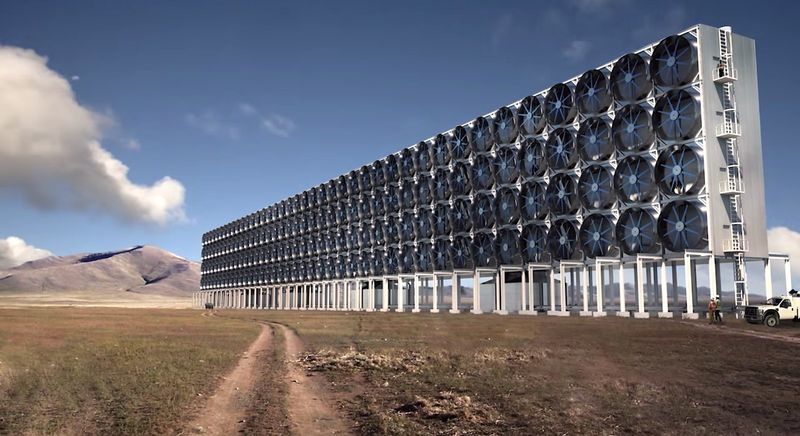
The best-funded of Canada’s carbon capture kings is Carbon Engineering, a direct air capture company, which has already received $68 million in investment from the likes of Bill Gates and Chevron Energy Technology Ventures. They aim to purify atmospheric CO2 for under $100/ton and turn it into ultra-low carbon fuels that can power existing cars, trucks and airplanes without any modifications.
Another British Columbia startup, Inventys, has developed an adsorption material that draws CO2 from industrial flue gas stacks
Meanwhile, on Canada’s Atlantic coast, Carbon Cure Technologies is capturing CO2 and converting it into a mineral to make a lighter, stronger and lower-carbon concrete, in essence capturing two high emitting industries with one stone. (Sorry about the pun.)
Consumer Focused Carbon Capture
Leave it up to American entrepreneurialism to solve a problem by creating consumer demand, which is precisely what California company, Newlight Technologies, is doing by capturing dairy methane, mixing it with air and enzymes in a bioreactor to create a material already being used to make desk chairs, computer packaging and smartphone covers.
Like every cleantech sector, California is awash in carbon capture and utilization companies with commercial applications. Among the more notable companies:
- Blue Planet gets as much notice for Board Member Leonardo DiCaprio as it does for using CO2 as raw material for making carbonate rocks, which replaces natural limestone rock mined from quarries, to produce cement.
- Chemetry uses CO2 to make industrial chemicals.
- Opus 12 is perhaps the most ambitious of the California carbon capture community, mixing CO2 emissions with water and electricity to replace petroleum in fuels and plastics.
Several other high profile companies recycle carbon into products like LanzaTech, but I didn’t include them even though they perform groundbreaking work because they aren’t in the business of carbon capture. Of course, this group of companies will be the offtakers for the volumes of captured carbon in the future, so their success is vital to the CCU cycle.
Thanks to all of these pioneers, we might be able to breathe easier and tip the scales towards a more habitable planet.
If you need help telling your cleantech story, contact me to set up a free 30-minute consultation.
The post Is Carbon Capture Coming Of Age? appeared first on Michael's Marc.