
Our Marketing Readiness Guide Will Help You Scale Your Science
You didn’t start your cleantech company to become a marketer.
You started it to solve a real problem. To build something that matters. To change an industry. Maybe even to change the world.
But here’s the uncomfortable truth:
Your science will not scale if your story isn’t ready.
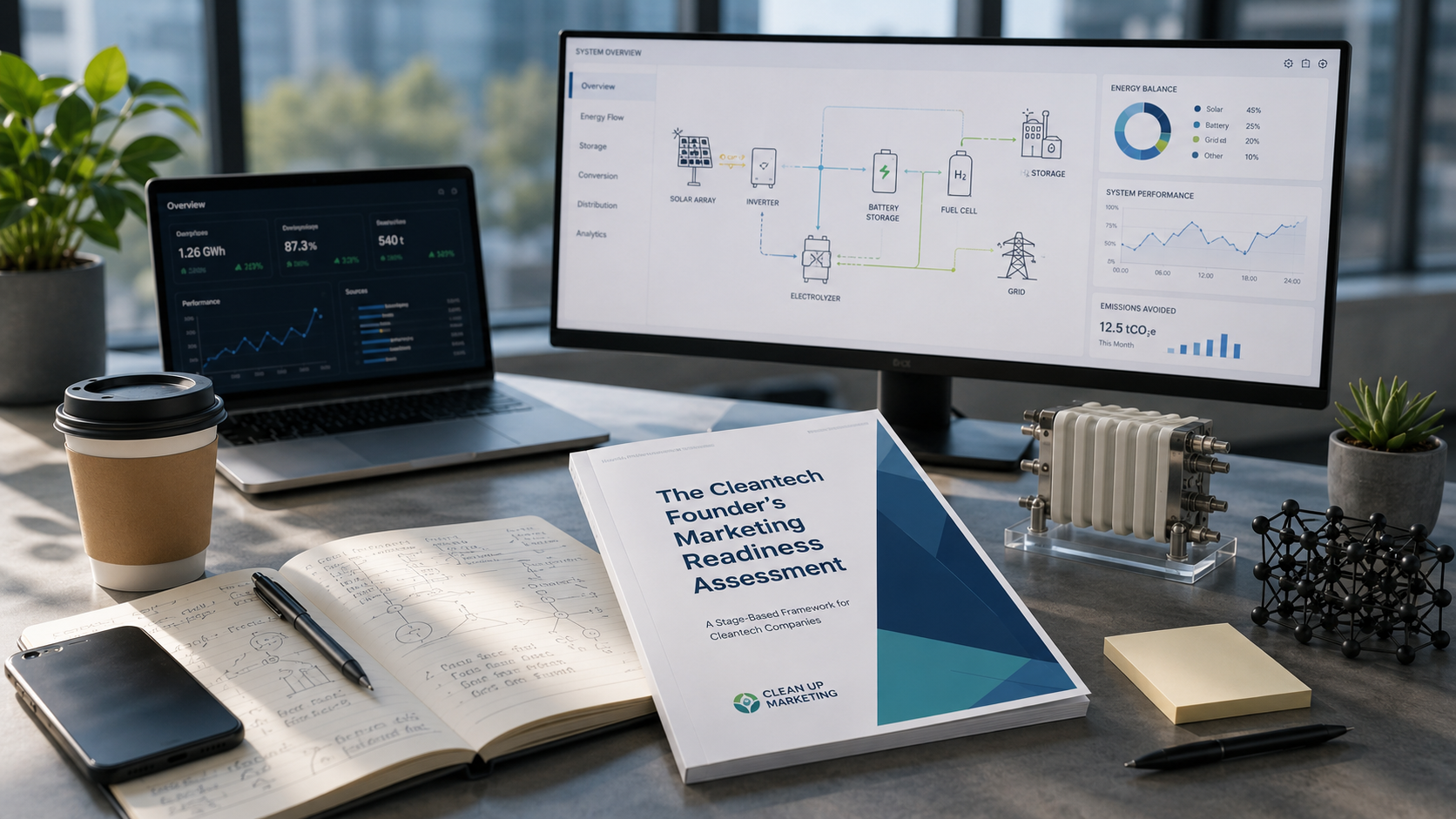
That’s why we created The Cleantech Founder’s Marketing Readiness Assessment — a practical, stage-based tool designed to help you identify whether your messaging, positioning, and marketing infrastructure are actually prepared to support growth.
Because the cleantech graveyard isn’t full of bad ideas. It’s full of brilliant technologies that couldn’t communicate their value.
Breakthrough Clean Technologies Don't Sell Themselves
Many founders assume that breakthrough science is enough. That investors will recognize brilliance. That customers will line up if the solution is technically superior.
They won’t.
Not because the science isn’t impressive — but because the market doesn’t evaluate science the way founders do.
Markets evaluate clarity.
- Can you explain the problem in one sentence?
- Can you identify exactly who you serve?
- Can your team describe your differentiation without saying “better, faster, cheaper”?
- Does your homepage make your audience feel recognized in the first 10 seconds?
If those answers aren’t immediate and consistent, scaling becomes exponentially harder.
Scaling Climate Tech Companies Requires More Than Funding
Most cleantech companies think they need more capital to grow. In reality, many need clearer messaging first.
The Marketing Readiness Assessment is structured by company stage because messaging gaps look different depending on where you are.
The assessment breaks readiness into:
- Pre-Seed → Message Foundation
- Seed / Series A → Message Clarity + Message Traction
- Series B+ → Market Leadership
Each stage builds on the previous. You shouldn't skip ahead. Why?
You cannot build traction without clarity. You cannot claim leadership without traction.You cannot scale without foundation.
Climate Tech Pre-Seed Companies: Is Your Message Foundation Solid?
At this stage, scaling your science means answering questions like:
- Can you explain the problem you solve in one sentence?
- Can you identify your top targeted audience?
- Can you articulate why previous solutions haven’t worked?
- Do you know your TAM, SAM, and SOM?
- Does your homepage clearly identify your audience and problem in the first 10 seconds?
Most early-stage founders struggle here.
Not because they don’t understand their technology.But because they haven’t translated their science into language the market understands.
Without that translation layer, you can’t raise effectively. You can’t win grants consistently. You can’t attract the right partners.
Science without narrative is invisible.
Seed / Series A Climate Tech Companies: Message Clarity Determines Momentum
By the time you reach Seed or Series A, your challenge shifts.
You’re no longer proving that your idea works. You’re proving that your company works.
At this stage, you need message clarity and team alignment.
Ask yourself:
- Does your C-suite use the same language to describe your value proposition?
- Can your staff explain your differentiation without defaulting to jargon?
- Can everyone cite your top three proof points?
- Do you have a formal message playbook?
Here are common red flags:
- Different team members describe your company differently.
- Investors ask, “So what do you actually do?”
- Your website bounce rate is high.
- You’re competing on “better, faster, cheaper.”
- Your pitch deck is overloaded with technical detail.
- You can’t explain your value prop without jargon.
If even two of those apply, message clarity isn’t optional. It’s urgent.
Scaling science requires consistency. If your internal team isn’t aligned, the market won’t be either.
Cleantech Message Traction: Are You Actually Reaching the Market?
Even with clarity, traction requires infrastructure.
This stage evaluates whether your message is reaching people consistently. It covers:
- Homepage clarity
- Growing website traffic
- SEO optimization
- Automated contact funnels
- LinkedIn presence
- Branded YouTube channel
- Explainer video
- Regular newsletter
- Analytics tracking
Many founders assume they have traction because they attend conferences or post occasionally on LinkedIn. That’s not traction. That’s activity.
Traction means:
- Consistent traffic growth
- Measurable engagement
- Growing subscriber lists
- Clear calls to action
- Systems that convert awareness into conversations
Scaling your science requires systems — not sporadic marketing.
Series B+: Market Leadership Is About Discipline
Once you reach later stages, the bar gets higher.
Market leadership readiness includes:
- A written marketing plan with GTM strategy and budget
- Sales and marketing alignment
- A scalable CRM
- Brand guidelines
- A messaging matrix
- Regular analytics reporting
- PPC campaigns
- Improving organic rankings
- A message playbook for new staff
At this stage, marketing isn’t optional. It’s operational. You’re not just telling a story — you’re institutionalizing it.
If your science is scaling but your narrative discipline isn’t, cracks will appear. Mixed messaging. Sales friction. Investor confusion.
Leadership requires clarity at scale.
Why This Cleantech Marketing Assessment Guide Is Different
The Marketing Readiness Assessment isn’t theoretical. It’s not a branding manifesto. It’s a practical scoring system.
You score each section and interpret results based on:
- 80–100% → Ready to Scale
- 50–79% → Gaps to Address
- 0–49% → Foundation Needed
This removes guesswork.
It replaces vague feelings like “We should probably work on marketing” with specific insight like:
- “Our homepage doesn’t identify our audience clearly.”
- “Our team uses inconsistent language.”
- “We don’t have a clear TAM/SAM/SOM.”
- “We lack a messaging matrix.”
Scaling science requires precision. Your marketing should be just as precise.
Scaling Climate Tech Isn’t About Doing More — It’s About Doing the Right Things
The guide also emphasizes prioritization:
- Focus on your current stage first.
- Address “No” items before “Needs Work.”
- Look for patterns in weak areas.
- Reassess quarterly.
Many cleantech companies jump to advanced tactics — paid ads, white papers, conference booths — without securing foundational clarity.
That’s like scaling a manufacturing process before validating yield consistency. The result? Burned capital and stalled momentum.
Make Your Story as Powerful as Your Science
Your technology may be groundbreaking. But if:
- Your homepage doesn’t clearly state who you serve,
- Your pitch deck confuses investors,
- Your team uses inconsistent language,
- Your marketing systems aren’t built for growth,
...then your science remains stuck. Market readiness isn’t about hype. It’s about clarity, alignment, and infrastructure.
What Happens To Your Cleantech Company When You Close the Gaps
When founders complete the assessment honestly, they gain:
- Clear understanding of where messaging breaks down
- Alignment between science and narrative
- Better investor conversations
- Stronger website performance
- More consistent lead generation
- More confidence in go-to-market strategy
That’s what allows science to scale. Because at the end of the day, markets don’t adopt technology. They adopt solutions they understand.
Your Next Step...
If you haven’t completed the Marketing Readiness Assessment yet, start there.
Score yourself honestly.
Identify your weakest section.
Then build from the foundation up.
If you want help interpreting your results, schedule a consultation to translate your scores into an action plan. Scaling science requires more than engineering discipline. It requires narrative discipline.
Your technology deserves a story that can carry it to market. And our Market Readiness Guide is the first step toward making that happen.